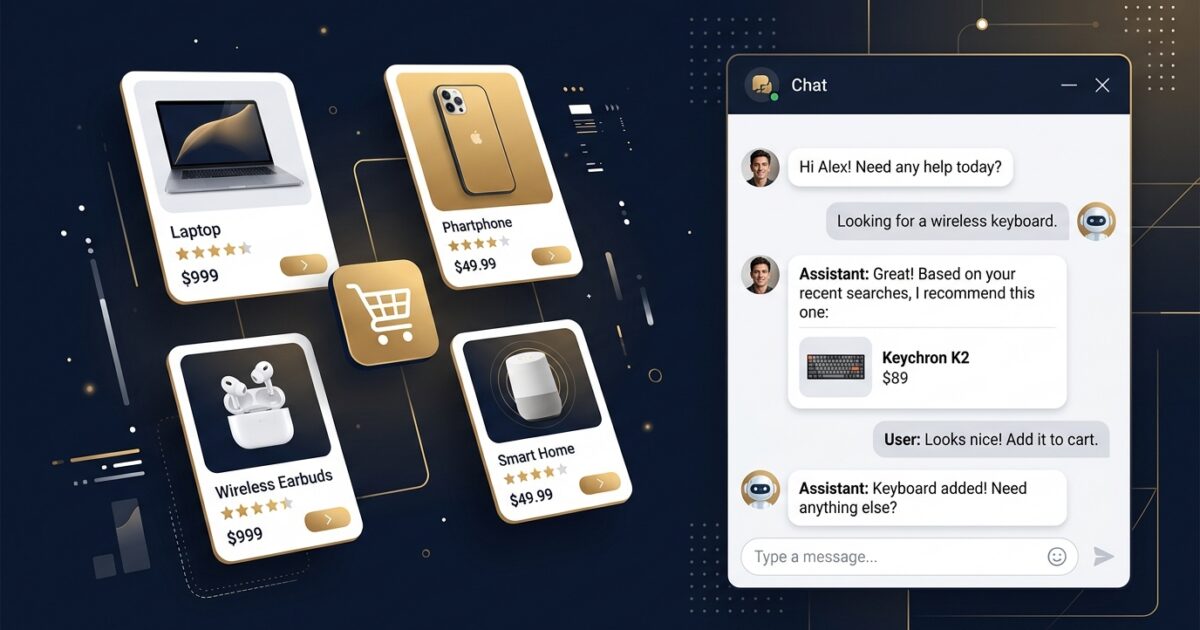
Quick Summary
- Modern e-commerce chatbots are sophisticated sales tools that guide customers from product discovery to checkout, significantly reducing cart abandonment.
- Key capabilities include natural language product search, in-chat cart building, and integrated payment processing to create a frictionless buying journey.
- Effective deployment requires a multi-channel strategy across your website, WhatsApp, and social media to engage customers on their preferred platforms.
- These AI assistants integrate directly with existing e-commerce platforms like Shopify and WooCommerce, syncing with live inventory and order data for accuracy.
The Role of an Ecommerce Chatbot in Modern Retail
Standard e-commerce conversion rates hover between 2-3%, meaning the vast majority of website visitors leave without making a purchase. They face common points of friction: they can’t find a specific product, have a question about shipping, or get distracted during checkout. In a physical store, a sales associate would resolve these issues, but online, this friction often leads to a lost sale.
An e-commerce chatbot acts as a dedicated digital sales associate, available 24/7. It engages customers at the precise moment of intent, answering questions and guiding them through the purchasing process. This transforms the passive browsing experience into an active, conversational one that directly addresses customer needs in real time.
Unlike outdated, rule-based bots, modern conversational AI understands natural language. It doesn’t just answer pre-programmed questions; it facilitates the entire buying journey, from initial query to post-purchase support.
Guided Product Discovery
A website’s search bar is often too literal to be effective. A customer searching for a “warm jacket for skiing” might get zero results if your products are labeled “thermal winter coats.” An AI-powered chatbot understands user intent and context.
It can process complex requests like, “Show me waterproof boots under $150 in a size 9,” instantly filtering your product catalog and presenting the most relevant options directly in the chat. This mimics the personalized service of a knowledgeable in-store employee.
Frictionless Cart and Checkout Management
Cart abandonment is a major challenge, frequently caused by unexpected costs or technical issues at checkout. An intelligent assistant can intervene proactively if a user hesitates on the payment page, offering to clarify shipping costs, apply a discount code, or answer last-minute questions.
Furthermore, advanced chatbots allow customers to add items to their cart directly within the conversation. A simple command like, “Add the blue one to my cart,” keeps the user engaged and streamlines the path to purchase by minimizing clicks and page loads.
Automated Post-Purchase Support
The most common customer service query is, “Where is my order?” (WISMO). Manually handling these inquiries consumes significant support resources. A chatbot integrated with your fulfillment system can provide instant, automated order status updates.
When a customer asks for an update, the AI retrieves real-time tracking data and provides an estimated delivery date. This resolves the customer’s issue immediately and frees up your human agents to handle more complex support cases.
Key Deployment Channels for Maximum Impact
To be effective, your conversational AI must meet customers on the platforms they already use. A multi-channel strategy ensures you are present at every potential touchpoint, reducing friction and capturing sales that might otherwise be lost.
On-Site Website and App Widgets
The classic website chat widget is a powerful tool when used proactively. Instead of waiting passively, it can trigger based on user behavior, such as lingering on a product page or the checkout screen. A targeted message like, “Need help with sizing for this item?” can engage a high-intent visitor before they decide to leave.
WhatsApp and Messaging Apps
With open rates exceeding 90%, WhatsApp is a dominant platform for conversational commerce. By enabling customers to browse products, ask questions, and complete orders entirely within the app, you create a highly convenient and personal shopping experience. This channel is especially effective for building direct customer relationships and driving repeat business.
Social Media DMs (Instagram & Facebook)
Social commerce is driven by impulse. When a potential customer discovers a product on Instagram and sends a direct message with a question, an immediate response is critical. An AI assistant can instantly answer queries, confirm availability, and guide the user to purchase directly within their DMs, capitalizing on that peak moment of interest.
Essential Capabilities of a Revenue-Driving AI
Not all chatbot platforms are built for the demands of e-commerce. To effectively turn conversations into revenue, the system must possess specific commerce-focused features that go beyond simple text responses.
Real-Time Catalog Integration
Your AI assistant must have a live connection to your product inventory. There is nothing worse than a chatbot recommending a product that is out of stock. Real-time synchronization ensures that all recommendations are accurate, prices are current, and promotions are applied correctly, preventing customer frustration.
In-Chat Payment Processing
The goal is to keep the entire transaction within the conversation. Redirecting a user to a separate checkout page introduces a potential point of failure. A modern e-commerce AI integrates with payment gateways to generate secure payment links directly in the chat, allowing customers to pay in seconds using methods like Apple Pay or Google Pay.
Multi-Language and Global Support
E-commerce provides a global reach, but language barriers can be a significant obstacle. An advanced AI can automatically detect a user’s language and respond fluently, providing a localized experience without the need for a large, multilingual support team. This capability unlocks new international markets and builds trust with a global customer base.
Visual and Voice Search
Customers don’t always know how to describe what they want. The ability to upload an image and have the AI perform a visual search against your catalog provides an intuitive way to find products. Similarly, accepting voice inputs on mobile devices makes the shopping experience faster and more accessible for on-the-go users.
Integrating AI with Your Existing Ecommerce Stack
Implementing a conversational AI solution does not require you to overhaul your existing infrastructure. Modern platforms are designed for seamless integration with the tools you already use, whether your store is built on Shopify, WooCommerce, Magento, or a custom backend.
Connection is typically handled through APIs or pre-built plugins. The AI pulls essential data—like product details, inventory levels, and customer history—from your store and pushes back new information, such as completed orders or updated customer profiles. This ensures data consistency across your entire operational stack.
Platforms like Artin SmartAgent are designed to simplify this process. By connecting your product feed and defining your brand’s tone, the AI learns your catalog and is ready to act as an intelligent layer on top of your e-commerce platform, minimizing development time and technical overhead.
To understand how this technology applies beyond retail, explore these AI chatbot for business use cases for a broader perspective on automation. For smaller operations, our chatbot for small business guide offers a practical roadmap for getting started without a large enterprise budget.
Upgrade Your Digital Storefront
Relying on a passive website and static product pages means leaving revenue on the table. An intelligent conversational assistant bridges the gap between casual browsing and a confirmed sale by delivering the personalized, immediate support that modern customers expect.
By automating the sales process and providing 24/7 support, you can reduce cart abandonment, increase customer satisfaction, and drive significant growth. It is time to stop losing customers to friction and unanswered questions.
Explore how advanced conversational AI can transform your retail operations. See our solutions in action by visiting Artin SmartAgent Wholesale Smart.
Frequently Asked Questions
How does an e-commerce chatbot increase sales?
An e-commerce chatbot increases sales by proactively engaging visitors, answering product questions instantly, guiding users to the right products, and simplifying the checkout process. By reducing friction and preventing cart abandonment, it directly boosts conversion rates and can also increase average order value through intelligent upselling and cross-selling recommendations.
Can a chatbot integrate with my existing platform like Shopify or WooCommerce?
Yes, modern conversational AI platforms are designed to integrate seamlessly with major e-commerce systems, including Shopify, WooCommerce, Magento, and BigCommerce. Integration is typically handled through pre-built apps or APIs, allowing the chatbot to sync with your live product catalog, inventory levels, and order management system.
What is the difference between a simple chatbot and a conversational AI for e-commerce?
A simple chatbot follows a rigid, pre-programmed script and can only answer basic FAQ-style questions. A conversational AI for e-commerce uses Natural Language Processing (NLP) to understand user intent, manage complex queries, facilitate product discovery, process transactions, and personalize the entire shopping journey from start to finish.
Is setting up an AI chatbot a complex and time-consuming process?
No, advanced platforms like Artin SmartAgent have streamlined the setup process. Implementation typically involves connecting your product feed and customer service data, configuring your brand’s tone, and deploying the widget to your site. The AI learns from your data, minimizing the need for manual script writing and allowing for a rapid deployment.
Ready to Auto-Convert Your Traffic?
Stop bleeding leads. Deploy the Artin SmartAgent AI on your WhatsApp and Website in exactly 24 hours.
Get Started — 14-Day Free Trial