A shop owner I spoke with recently had sat through four demos of AI ordering tools in one week. All four demos worked. All four salespeople were pleasant and quick with answers. She came out of the week less certain than when she went in, because not one of them had told her what happens on a normal Tuesday afternoon when a customer sends a voice note in rough English asking for a product that is out of stock, then changes the quantity twice, then asks for a discount.
That gap between a smooth demo and an ordinary Tuesday is where most of the money gets wasted in this category. The demo is built from clean data, a short script and a happy customer. Your business runs on messy data, interruptions and customers who do not follow scripts. So the demo tells you almost nothing about whether the tool will survive in your shop, and watching more demos will not fix that.
There is a second reason to be careful right now. Gartner’s analysis, reported by Forbes in July 2026, found that of the thousands of vendors claiming agentic AI capability, only around 130 were building systems that genuinely deserved the label. The rest were chatbots, scripted flows and old automation with new wording on the website. Gartner also expects more than 40 percent of agentic AI projects to be cancelled by the end of 2027, with unclear business value as one of the main reasons. You are shopping in a market with a lot of relabelled software in it, and the burden of telling the difference sits with you.
The good news is that you do not need technical knowledge to do this well. You need a short list of questions, the willingness to ask them in writing, and the patience to notice when an answer is not an answer.
Start by changing what you think you are buying. You are not buying software. You are buying a change in the way orders arrive in your business. That means the only sensible first question is about your own operation, not about the product. Write down, in one page, how an order reaches you today, who touches it, how long each step takes and where things go wrong most often. If you cannot describe that, no vendor can tell you honestly whether their tool helps, and any number they give you about time saved is invented. This page is also the thing you will compare the tool against later, so keep it.
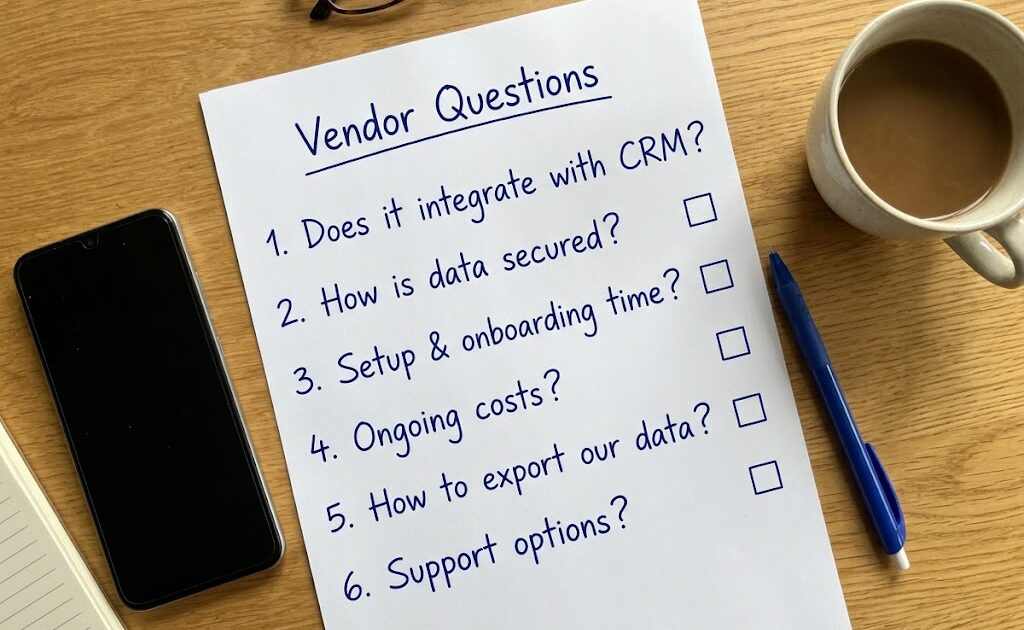
Then ask the vendor exactly what the tool does without a human in the loop. Not what it can do. What it does, by default, on day one. An AI agent that answers questions is a very different purchase from one that takes an order, confirms stock and issues an invoice, and the word agent is used for both. Ask where the handoff rule sits, meaning the point at which the conversation stops being automatic and lands with a person. If the answer is that it never needs a human, be suspicious. Every ordering system needs a person for the odd cases, and a vendor who will not admit that has either not run it in a real business or is not telling you the whole story.
The next question is the one most buyers skip. What happens when it gets something wrong? Wrong price, wrong quantity, wrong product because two items have similar names. Ask to see where that failure shows up and who finds out first, you or the customer. A tool that quietly sends a wrong confirmation is worse than no tool. A tool that flags the uncertain cases and asks you is worth paying for. This single question separates products built by people who have watched real orders go through from products built around a demo.
After that, ask about your data, and ask it plainly. Who owns the conversations and the customer list. Can you export your customers, your orders and your product catalogue yourself, today, without asking permission, and in what format. What happens to that data if you stop paying. Where is it stored. If a vendor hesitates on the export question, you are looking at a tool that will be expensive to leave, and the cost of leaving is part of the price even if it never appears on the invoice.
Setup is the next place where quotes and reality separate. Ask how many hours of work the vendor needs from you and your staff, not how many hours they will spend. Someone on your side has to supply the product list, the prices, the delivery rules and the answers to the twenty questions customers actually ask. That work is real and it is yours. Ask what the tool needs in order to work properly and what it does when that information is missing or stale. A tool that keeps selling something you stopped stocking will cost you customers.
On messaging channels, get the ownership question settled before you pay anything. If WhatsApp is involved, ask whose account and number the business runs on, who is billed by Meta for the conversations, and what happens to that number if you change provider. The honest answer is usually that the business should own its own number and pay Meta directly, with the vendor charging only for installing and configuring it. If the vendor keeps the number, your customer relationship sits inside someone else’s account.
Then do the arithmetic properly. Ask for the total cost in month one and the total cost in month twelve, including setup, messaging charges, payment processing and anything priced per conversation or per order. Monthly subscription is rarely the whole number. Ask what happens to the price if your order volume doubles, because a tool that is cheap at fifty orders a day and painful at five hundred is a problem you are buying on purpose.
Ask for references you can actually speak to, in a business roughly your size and ideally in your sector. One real twenty minute phone call with another owner is worth more than every case study on the website. If the vendor cannot produce one, that is information too, and it does not automatically mean no. A young product with two honest customers can be a better bet than a polished product with invented numbers, as long as you know which one you are buying.
Finally, insist on a test with your own catalogue and your own customers, and define the pass mark before the test starts. Pick something you can count. Twenty real conversations, and you will accept it if a set number of orders come through correctly with no help from you and nothing wrong reaches a customer. Write that number down in advance, because deciding afterwards is how people talk themselves into a tool that did not work. Two weeks is usually enough to see the pattern.
A few answers should make you stop. A vendor who says yes to every feature request in the first call, a vendor who quotes impressive percentages with no customer name and no method behind them, a vendor who cannot describe in plain language what the tool actually does when a message arrives, and a vendor who wants an annual prepayment before you have run a single real conversation through it. None of those are fatal on their own. Together they are a pattern.
It would be dishonest to publish this list and then exempt my own product from it, so apply every question above to Order Smart as well. What it is, honestly, is an AI ordering agent that works on the channels your customers already use, meaning WhatsApp, Telegram and a widget on your own website, with a dashboard where orders and customer history land so you are not scrolling through chats to find things. It is multi tenant, which means your data sits in your own tenant and is not mixed with another business. Setup for the website widget is straightforward, and for WhatsApp the business owns its own account and number and is billed by Meta directly, with our fee covering installation and configuration only.
The specifics you should ask me for in writing, exactly as you would ask anyone else, are the trial terms [Arezoo to confirm], realistic setup time for a business your size [Arezoo to confirm], the current list of integrations [Arezoo to confirm], the data export and deletion policy [Arezoo to confirm], support response times [Arezoo to confirm], and contract and cancellation terms [Arezoo to confirm]. If an answer to any of those is not clear enough to put in an email, that is a reason to wait, and that applies to us too.
Run the questions on three vendors. You will learn more in those three conversations than in a month of reading comparison pages, and whichever way you decide, you will be deciding about your own business rather than about someone’s demo.
Ready to Auto-Convert Your Traffic?
Stop bleeding leads. Deploy the Artin SmartAgent AI on your WhatsApp and Website in exactly 24 hours.
Get Started — 14-Day Free Trial