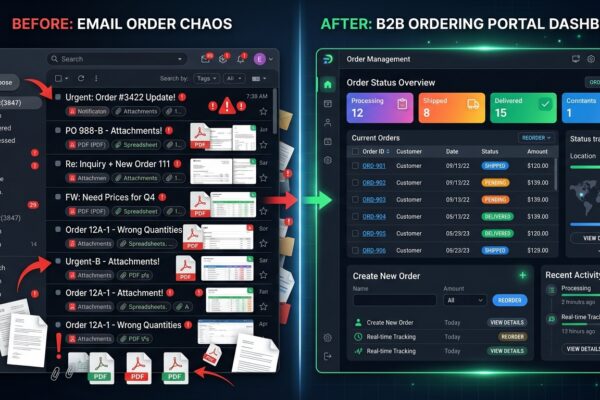
Nobody sits down and decides to run their ordering on a chat app, a sheet and a phone. It happens the way most things happen in a growing business. A customer sends a message instead of calling, so you answer it there. Someone needs to know what is in stock, so you open a sheet and start typing. A supplier prefers to talk, so you keep taking calls. Two years later that accidental arrangement is quietly running the part of your business that brings in the money.
And it works. That is the part people do not want to hear. The patch works well enough for a long time, which is exactly why it never gets fixed. It holds until volume rises, or your most experienced person takes leave, or a week gets busy enough that two people touch the same order. Then it comes apart all at once, usually in front of a customer.
This is not an argument that spreadsheets are bad or that chat has no place in sales. Both are useful. The trouble starts with what happens between them, and with a handful of specific mistakes that almost every business makes on the way.
The first mistake is treating the chat thread as the order record. A conversation is a good place to agree on something and a poor place to store it. Details arrive in pieces, spread across voice notes, a photo of a handwritten list and a correction sent an hour later. Nothing is labelled, nothing can be sorted, nothing can be counted. When you need to know what the customer actually asked for, you scroll. Scrolling is not a system. And the thread usually lives on one phone, which means if the person holding that phone leaves, part of your order history walks out with them.
The second mistake is giving the spreadsheet a job it was never designed to do. A sheet is excellent at calculation and completely indifferent to truth. It will happily let two people open the same file and save two different versions of reality. It has no idea that row 48 was already shipped, that row 51 was cancelled by phone, or that the tab called final is older than the one called final new. There is no record of who changed what, so when a quantity is wrong nobody can reconstruct how it got that way. The sheet is not lying to you. It simply has no mechanism for telling the truth.
The third mistake is leaving stock knowledge in somebody’s head. In most small operations there is one person who really knows what is on the shelf, what is damaged, what is promised to a regular customer and what the supplier is slow with. That knowledge is the most valuable asset in the warehouse and it is stored in the one place you cannot back up. Every time an order is confirmed on the strength of what that person remembers, you are making a promise on unverified information.
The fourth mistake is having no shared words for where an order is. Ask three people in a business like this whether an order is done and you can get three honest answers that all mean something different. One means the customer confirmed, one means it was packed, one means the money arrived. Without agreed status words, every question about an order turns into a small investigation, and the person doing the investigating is usually the owner.
The fifth mistake is measuring none of it. Most owners feel the cost of the patch without ever seeing a figure for it. They know the week was hard. They do not know that eleven orders needed a correction, that four arrived after hours and sat unanswered until morning, or that the same customer asked for a status update three times.
I am not going to hand you an industry statistic here, because the only number that matters is yours and it is not hard to get. Take one normal week. Count how many orders came in, and through how many different channels. Count how many had to be corrected after they were entered. Count how many arrived outside working hours, and how long each one waited for a reply. Then estimate honestly how many minutes each order takes between the first message and a clean record someone can act on. Multiply it out. That is your real cost, and it tends to be larger than people expect, because the retyping never appears on a payroll line as retyping. It appears as a salesperson who is somehow always busy.
There are three costs in that patch that rarely get counted. The first is error, and errors in orders are expensive in a way that errors in marketing are not. A wrong quantity means a second delivery, a credit note, an apology and a customer who now checks everything you send. The second is the orders you never knew you lost. A message that arrives at nine in the evening and gets answered at ten the next morning is often already somewhere else. You do not see that loss, because nothing appears in the sheet to tell you it happened. The third is attention. When the system only works because the owner remembers everything, the owner cannot leave, cannot plan and cannot hire, because none of the rules have been written down and so none can be handed over.
The good news is that most of the repair is not software. It is agreement.
Start by narrowing where orders are allowed to arrive. You do not need to force every customer onto a form, and with some customers you should not try. But an order that arrives by chat should be copied into one place immediately, by the person who received it, in the same shape every time. One place that holds the truth, and everything else treated as a conversation about it.
Then write down the status words and make everyone use them, including you. Four or five are usually enough to cover the life of an order, from the moment it is requested to the moment it is paid. The point is not elegance. The point is that two people reading the same word picture the same thing.
Then get the rules out of people’s heads and onto paper. What is the minimum order. Who gets credit terms and how long. What happens when an item is short, do you part ship or hold. Which customers always get called before a substitution. These rules already exist, they are just stored in the memory of whoever has been there longest. Written down, they can be followed by a new employee, and they can be followed by software. Left unwritten, no tool on the market will help you, because you will be asking it to automate something nobody has defined.
Only after that does it make sense to look at tools, and this is where it is worth being clear about what an AI agent is actually good at.
An agent is genuinely strong at the messy front end. Reading an incoming message that was written by a human in a hurry, pulling out what was ordered and how much, asking a clarifying question when something is ambiguous, confirming back to the customer in plain language, and producing a structured record out of all that. It is also good at the small repetitive follow up nobody has time for, the status answer, the reminder, the nudge when a confirmation never came.
It is not magic in the places people hope it will be. It cannot make bad stock data good. If your quantities are wrong, an agent will confirm orders you cannot fulfil, faster than a human would. It should not be the final word on credit, discounts or anything else where a wrong answer costs real money, and a sensible setup keeps a person in that loop. It will not hold a relationship with your three biggest accounts. Those people called you because they want you, and automating them is a way to lose them politely.
Order Smart is built for the gap described above, the space between a customer’s message and a clean order record that your team can act on. [Arezoo to confirm: which channels Order Smart reads, for example WhatsApp, a web form, email intake or a phone transcript] and [Arezoo to confirm: whether it keeps its own order records or writes into a stock or accounting system you already use]. What I will not do is put a number on hours saved, because that depends entirely on your volume and on how messy your intake is today. If you want an honest estimate, measure your own week first using the counts above, and then ask any vendor, including us, to show you how their tool handles your three ugliest orders rather than a clean demo.
One last practical thing you can do this week. Pick a single order from the last few days, ideally one that went wrong, and trace it backwards through every message, every change in the sheet and every phone call about it. Count the hands it passed through. Most owners who do this find two or three steps that exist for no reason other than that nobody ever removed them. That hour will tell you more about your operation than any software comparison.
If you would like the shorter version of this to share with your team, [Arezoo to add link to the LinkedIn companion article], and if you want to talk through what your own order path looks like, send a message with your week’s numbers and we can look at it together.
Ready to Auto-Convert Your Traffic?
Stop bleeding leads. Deploy the Artin SmartAgent AI on your WhatsApp and Website in exactly 24 hours.
Get Started — 14-Day Free Trial