Quick Summary
- Custom B2B ordering portals are a significant capital expenditure (CapEx) burdened by high development costs, complex ERP integration, and ongoing maintenance fees.
- The primary risk of a portal investment is low customer adoption, as buyers often resist changing their established ordering habits, negating the ROI.
- Email order automation is a low-risk operational expenditure (OpEx) that works with your customers’ existing workflows, processing orders directly from their emails.
- The automation model avoids development overhead and customer training, delivering a faster return on investment by focusing on internal efficiency.
Evaluating the Capital Cost of Custom B2B Portals
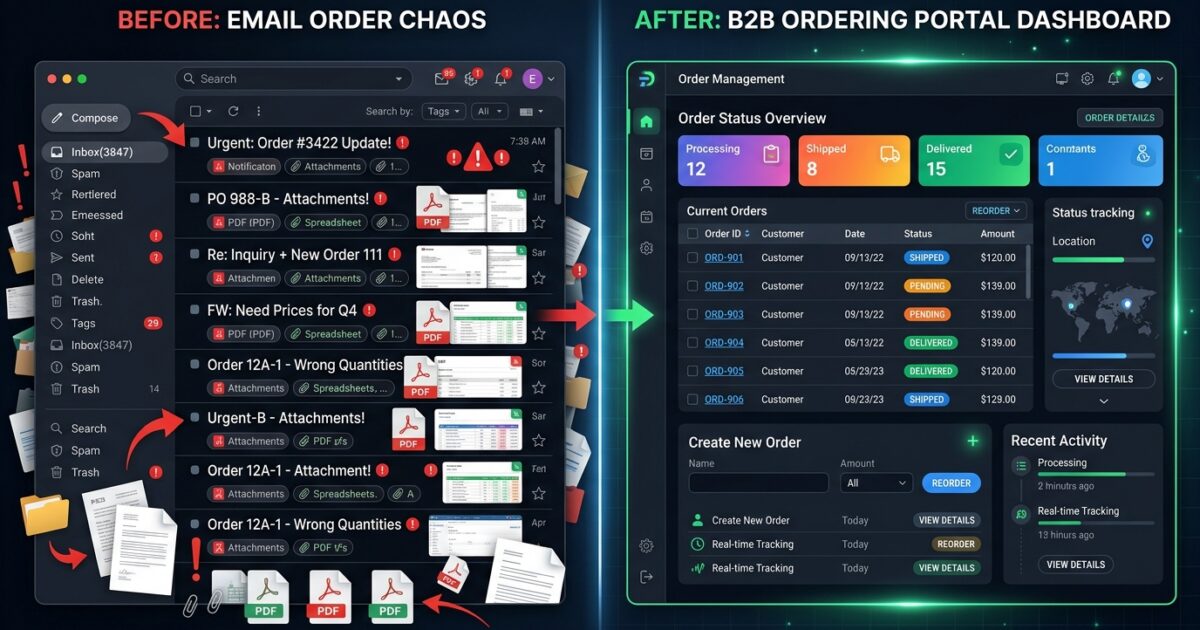
When seeking to eliminate manual order entry, many distributors consider a custom B2B ordering portal the default solution. However, commissioning a portal is not a simple website build; it is a major software development project that represents a significant upfront capital expenditure (CapEx).
The primary cost driver is the custom engineering required to create a secure, scalable platform. This platform must then be deeply integrated with your Enterprise Resource Planning (ERP) or other business systems to be effective.
This integration is critical for displaying accurate, customer-specific pricing and real-time inventory levels. The technical complexity of this connection is a common source of budget overruns and project delays, further inflating the total capital investment.
The Hidden Costs: Maintenance and User Adoption
The initial development budget is only the beginning of a portal’s total cost of ownership (TCO). All software platforms demand continuous maintenance to address security vulnerabilities, apply system updates, and adapt to changes in integrated third-party services.
Beyond proactive maintenance, you must budget for recurring operational costs. These include reliable web hosting to guarantee uptime and a support contract with a development partner to resolve inevitable bugs and performance issues.
The most significant and frequently underestimated cost is driving customer adoption. A portal only delivers value if customers use it, forcing your sales team to invest considerable time training buyers who may resist changing their efficient habit of ordering via email.
The Low-Friction Alternative: Automated Order Entry
A more effective strategy for order automation adapts to your customers’ existing workflows rather than forcing them into a new one. This approach removes the need to build, maintain, and promote a separate, customer-facing platform.
This method uses intelligent automation to process orders as they arrive through standard channels like email. The software reads incoming purchase orders, identifies products and quantities, and prepares the order for entry into your system without manual keying.
An order automation tool like Artin SmartAgent extracts order data, validates it against your product catalog, and drafts the sales order directly in your ERP. Your team only needs to review and approve the draft, while your customers continue to order exactly as they do today.
Comparing Financial Models: CapEx vs. OpEx
The choice between a portal and an automation tool is a fundamental financial decision: capital expenditure (CapEx) versus operational expenditure (OpEx). A custom portal is a CapEx model, requiring a large, upfront investment to build a tangible software asset.
In contrast, an order automation solution is a predictable OpEx, typically structured as a monthly subscription based on order volume. This model has no custom development costs, no hosting fees, and no security patch management for your team to handle.
The correct path depends on your capital availability and your customers’ willingness to adopt new technology. If your buyers are resistant to change, an internally focused automation solution will deliver a higher and faster return on investment.
Frequently Asked Questions
Why is a custom B2B portal considered a CapEx investment?
It involves a large, upfront cost for software development, systems integration, and infrastructure. This creates a long-term asset on the company’s balance sheet, which requires significant initial capital outlay and depreciates over time.
What are the “hidden” costs of a B2B ordering portal?
Beyond the initial build, total cost of ownership includes ongoing software maintenance, security updates, web hosting, and bug fixes. The most significant hidden cost is the internal labor required to train customers and persuade them to adopt the new platform.
How does email order automation avoid the user adoption problem?
Automation tools like Artin SmartAgent work in the background, processing orders from the emails that customers already send. This requires no change in customer behavior, completely eliminating the need for training, onboarding, and platform promotion.
What is the primary benefit of an OpEx model for order processing?
An OpEx model shifts the cost from a large, risky upfront investment to a predictable, scalable monthly subscription. This aligns expenses directly with business volume, preserves capital, and provides greater financial flexibility.
Ready to Auto-Convert Your Traffic?
Stop bleeding leads. Deploy the Artin SmartAgent AI on your WhatsApp and Website in exactly 24 hours.
Get Started — 14-Day Free Trial