Quick Summary
- The most valuable AI chatbot for a business is one that directly generates revenue, not just one that saves costs or qualifies leads.
- While customer support and lead generation bots are useful, sales and order-taking chatbots provide the most immediate and measurable financial return.
- The effectiveness of a chatbot depends on the use case; internal bots are often too costly for SMBs, while sales bots are transformative for B2B and e-commerce.
- Implementing sales automation on platforms your customers already use, like WhatsApp, dramatically reduces friction and increases order volume.
Evaluating AI Chatbot Use Cases by Business Impact
The market is saturated with claims about the necessity of AI chatbots. The narrative suggests that failing to adopt AI immediately is a critical business error. For pragmatic decision-makers, however, the primary concern is not hype but return on investment: which applications actually generate revenue?
Many businesses deploy AI without a clear strategy, adding a generic chat widget to their website and expecting transformative results. In reality, chatbot applications vary significantly in their financial impact. Some merely trim support costs, while others function as autonomous, 24/7 sales channels.
To make an informed investment, we must analyze the four primary business use cases for AI chatbots: customer support, lead qualification, internal operations, and direct sales. This analysis will clarify the costs, implementation difficulty, and true ROI of each.
Use Case 1: Customer Support (Cost Containment)
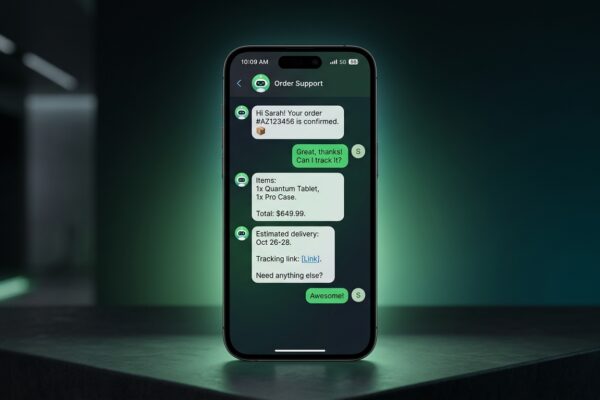
The most common entry point for AI adoption is customer support. A support chatbot is designed to handle routine inquiries, such as order status updates, shipping policy questions, and business hours. This automation frees up human agents to manage complex issues requiring critical thinking and empathy.
Implementation difficulty is moderate, requiring the AI to be trained on your knowledge base, FAQs, and historical support data. The primary benefit is cost savings achieved through reduced agent workload and 24/7 availability for basic queries. This improves customer satisfaction and retention.
However, a support bot is fundamentally a defensive, cost-saving tool, not a revenue generator. It optimizes existing operations but does not directly contribute to top-line growth. For a deeper analysis of this distinction, review our guide on customer service vs. sales chatbots.
Use Case 2: Lead Qualification (Pipeline Automation)
A lead qualification chatbot proactively engages website visitors to assess their needs, budget, and purchasing intent. Based on this dialogue, it can book meetings directly on a sales team’s calendar or guide prospects to relevant content, filtering out unqualified inquiries.
This use case is highly effective for B2B service firms and companies with high-value sales cycles. It functions as a digital gatekeeper, ensuring that sales professionals invest their time only on pre-qualified, warm leads. The ROI is clear: it saves significant time and directly improves sales pipeline efficiency.
While valuable, this system is an assistant, not a closer. It automates the top of the sales funnel, but the responsibility for converting the lead into revenue still rests entirely with a human agent.
Use Case 3: Internal Operations (Productivity Enhancement)
Internal chatbots are designed for employees, not customers. They serve as a centralized knowledge base for accessing HR policies, IT support guides, or project documentation, reducing the time employees spend searching for information or waiting for responses from other departments.
Implementation is complex and costly, requiring deep integration with secure internal systems, databases, and company wikis. For large enterprises with thousands of employees, the cumulative time savings can translate into millions of dollars in recovered productivity.
For most small to mid-sized businesses, however, the significant setup and maintenance costs rarely justify the return. A well-organized internal wiki or document repository is a far more cost-effective solution for organizations that do not operate at massive scale.
Use Case 4: Sales and Order-Taking (Direct Revenue Generation)
This is the most financially impactful use case. A sales and order-taking chatbot processes transactions from start to finish within the chat interface. Customers can browse products, confirm inventory, place complex orders, and submit payment without human intervention.
The ROI here is direct, immediate, and easily measured. Every order processed by the bot represents new revenue. This system operates 24/7 without holidays, providing a frictionless purchasing experience that encourages repeat business.
For B2B wholesalers, distributors, and high-volume e-commerce brands, transactional chatbots are a strategic imperative. They replace clunky portals and manual email orders with a seamless, conversational process. By making it easier to buy, you increase both the frequency and volume of sales.
Why WhatsApp is the Superior Channel for Sales
The platform for your sales bot is as critical as the AI itself. Website widgets are often ignored, and proprietary apps create adoption friction. The most effective channel is one customers already use daily: WhatsApp.
With open rates exceeding 90%, WhatsApp ensures your communications are seen. It allows you to send interactive catalogs and payment links directly in the conversation, enabling customers to place reorders or make new purchases with a simple message. Learn more about implementation in our guide on how to set up a WhatsApp AI chatbot.
Making the Strategic Choice for Your Business
When evaluating an AI chatbot, the critical question is whether the tool is designed to save money or to make money. While support and lead qualification bots provide value by optimizing processes, their impact on revenue is indirect.
An order-taking chatbot, by contrast, creates a direct line between interaction and transaction. By meeting customers on their preferred channels and removing all friction from the buying journey, you transform a conversation into a completed sale.
At Artin SmartAgent, we specialize in converting passive chat windows into active sales channels. When ordering becomes as simple as sending a text message, your business becomes the default, preferred vendor for your clients.
Automate Your Orders and Accelerate Revenue Growth
If you are a wholesaler or distributor burdened by manual order entry, outdated portals, and administrative overhead, it is time to modernize your sales process. Empower your customers to place orders in seconds via WhatsApp.
Discover how Artin SmartAgent can provide an intelligent, order-taking chatbot that drives measurable revenue, reduces operational costs, and delivers a decisive competitive advantage.
Frequently Asked Questions
What is the primary difference between a customer support bot and a sales bot?
A customer support bot focuses on post-sale issue resolution, answering questions, and reducing service costs. A sales bot is focused on pre-sale and in-sale activities, guiding customers through product discovery and processing transactions to directly generate revenue.
Which chatbot use case offers the highest ROI?
Sales and order-taking chatbots typically offer the highest and most direct ROI. Every successful interaction results in a measurable transaction and revenue, making its financial impact easy to track and justify.
Are AI chatbots difficult to implement for B2B companies?
The difficulty varies by use case. Lead qualification bots are relatively simple, while internal operations bots can be highly complex. A specialized B2B order-taking bot, particularly for a platform like WhatsApp, can be implemented efficiently with the right technology partner.
Why use WhatsApp for a sales chatbot instead of a website?
WhatsApp has near-perfect open rates (~90%) and allows customers to order from a familiar, trusted app on their phone. This removes the friction of visiting a website, logging into a portal, or downloading new software, which significantly increases conversion rates and customer loyalty.
Ready to Auto-Convert Your Traffic?
Stop bleeding leads. Deploy the Artin SmartAgent AI on your WhatsApp and Website in exactly 24 hours.
Get Started — 14-Day Free Trial