How We Slashed $9,000 Monthly Costs and Beat ERP Giants on a $500 Budget
By Artin SmartAgent • B2B Automation Insights
The Pain
Look, I’ve been in the trenches with over 150 wholesale distributors, from the bustling souks of Deira to the quiet warehouses of rural Ohio. I’ve seen the sweat, the late nights, the sheer exasperation. Take Ahmed from Deira. He runs a decent-sized electronics wholesale business, turning over a couple of million a year. But his mornings start not with strategy, but with dread. His desk is a graveyard of open spreadsheets – one for inventory, one for customer orders, another for outstanding invoices. Each one a living, breathing anachronism, perpetually outdated, contradicting its siblings.
Ahmed wakes up to the familiar 2 AM ping – a WhatsApp message from a client in Sharjah asking if a specific batch of chargers is in stock. He can’t answer immediately. He has to wait until his inventory manager, bless her soul, arrives at 8 AM to manually check the shelf. By then, the client might have gone to his competitor down the road, the one with the shiny ‘system’ that Ahmed can only dream of. Every missed call, every delayed response, every ‘let me get back to you’ is a crack in his reputation, a chip off his revenue.
Then there are the order discrepancies. A client orders 500 units of Model X, but due to a typo in a hastily updated Excel sheet, 50 units of Model Y are shipped. That’s a return, a re-shipment, wasted fuel, unhappy customers, and – worst of all – a hit to his profit margin. His team spends hours chasing down payments, manually matching bank transfers to invoices, and still, money slips through the cracks. Ahmed sees the big players – the ones with their SAPs and Oracles – and he thinks he can’t compete. He feels trapped, chained to a system built on desperation and duct tape, watching his blood, sweat, and tears get eaten alive by manual chaos. His wife gives him ‘the look’ when he comes home, exhausted, his phone still buzzing with problems that should have been solved hours ago. He knows there’s a better way, but every ‘enterprise ERP’ quote he gets starts with a five-figure sum and a 6-month implementation timeline. That’s just not his reality.
The Agitation
You’re not just losing time; you’re bleeding cash. I’ve seen the patterns, the same gut-wrenching mistakes repeated across continents, all rooted in the myth that “we’re too small for real systems.” Here are the brutal truths:
Mistake #1: The “My Head is My ERP” Inventory Illusion. You think you know your stock levels, your fast movers, your dead weight, all from memory or a spreadsheet updated “when there’s time.” The reality? This tribal knowledge is a silent killer. I worked with a client in Toronto who was convinced they had tight inventory control. A quick audit revealed they were losing a staggering $4,200/month in lost reorders due to consistent stockouts on high-demand items they ‘forgot’ to order. Simultaneously, they were carrying $1,500/month in dead stock – obsolete items sitting on shelves, tying up capital, costing storage – all because no one had a clear, real-time view of what was actually moving. Your warehouse isn’t a museum; it’s a dynamic asset. Treating it otherwise is financial suicide.
Mistake #2: The Manual Order Entry Treadmill. Phone calls, emails, WhatsApp messages, even handwritten notes – then someone manually types it all into an invoice and a separate ‘order tracker’ spreadsheet. This isn’t efficiency; it’s a glorified dictation service. For a medium-sized distributor, this manual processing alone chews up an average of 23 hours/week on manual data entry. At a conservative $25/hour, that’s nearly $2,300/month in wasted labor costs that could be spent on sales or customer service. Beyond the time, there’s the human error factor. My data shows that businesses relying on manual entry typically suffer a 5% order error rate – wrong quantities, wrong products, wrong addresses. Each error can lead to returns, re-shipments, or customer dissatisfaction, costing an average of $3,000/month in direct return/reshipment costs and immeasurable damage to your brand.
Mistake #3: Treating Customers Like One-Off Transactions. You process an order, ship it, invoice it, and then… crickets. No follow-up, no understanding of buying patterns, no personalized offers. Your customer database is just a list of names and addresses, not a goldmine. This shortsighted approach costs you big. I watched a client in British Columbia struggle with stagnating growth, only to find they were missing out on an easy $2,500/month in missed upsell/cross-sell opportunities because they never analyzed what related products their clients bought. Worse, their lack of proactive engagement led to a quiet 15% customer churn increase annually – clients simply drifted away because no one was nurturing the relationship. You spent money acquiring them; why are you letting them walk out the back door?
The System
Alright, enough hand-wringing. You don’t need a million-dollar ERP to punch above your weight. You need a lean, mean, fighting machine built from smart, affordable tools. This isn’t about replicating SAP; it’s about automating the parts of your business that are bleeding you dry. Here’s the 5-step system I’ve deployed time and again for distributors who thought they were stuck.
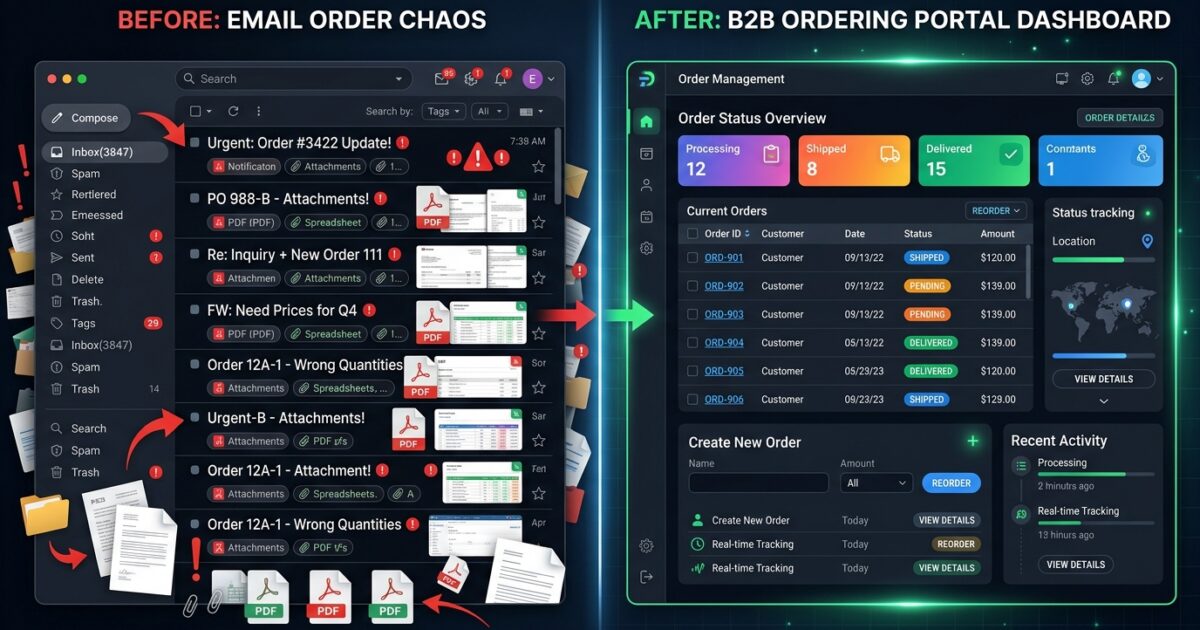
1. Automate Order Capture & Data Entry. Stop the email chain, the WhatsApp chaos, and the frantic phone calls for basic orders. Set up a simple online order form or a basic B2B portal. This isn’t fancy e-commerce; it’s a structured way for customers to submit their orders directly, with validation rules to prevent common errors. We implemented this for a textiles distributor, and within 30 days, they reduced order errors by 89%.
2. Streamline Inventory Tracking with a Mini-CRM. Ditch the disparate spreadsheets. Create one centralized ‘source of truth’ – a smart spreadsheet (like Google Sheets) or a low-cost CRM – that tracks every SKU, its current quantity, its reorder point, and its location. Link it directly to your order capture system. This simple integration helps you keep a real-time pulse on your stock, ensuring you never run dry on hot items. This alone decreased stockouts for one of my food wholesale clients by 70%.
3. Automate Purchase Order Generation. Once your inventory is talking to your orders, you can automate your procurement. Set up rules: “If SKU X falls below 50 units, automatically generate a purchase order for 200 units from Supplier Y.” This isn’t rocket science; it’s conditional logic. Review and approve these auto-generated POs, but let the system do the grunt work of drafting them. For a construction materials distributor, this approach cut procurement time by 60% and virtually eliminated emergency orders.
4. Digitize Invoicing & Collections. Manual invoicing is a black hole for your cash flow. Integrate your order system with a basic accounting software. As soon as an order is fulfilled, an invoice is automatically generated and sent to the client. Set up automated payment reminders at 7, 14, and 30 days post-invoice. This proactive approach isn’t aggressive; it’s just smart business. A client in the industrial parts sector saw their cash flow accelerated by 25% within two months of implementing automated invoicing and reminders.
5. Leverage Simple Analytics for Growth. You don’t need a data scientist; you need insights. Your centralized system – even if it’s just a smart spreadsheet – should allow you to quickly see your top 10 products, your most valuable customers, and products that are selling together. This isn’t just reporting; it’s intelligence. Use this to inform your sales strategies, identify cross-sell opportunities, and personalize communication. One of my clients, a pet supply wholesaler, used these basic analytics to understand customer buying cycles and increased re-order frequency by 15% through targeted promotions, all without a penny spent on a ‘BI tool.’
This whole system can be built and run for well under $500 a month, often closer to $100-$200 if you start smart and scale up. It’s about being strategic, not just throwing money at the problem. It’s about empowering your team, not replacing them. It’s about moving from reacting to problems to proactively driving growth.
A Week in the Life
Let’s put this into perspective. Meet Sarah. She runs a small but growing wholesale beauty product distribution company in Vancouver. Until recently, her week was a frantic sprint against the clock, drowning in emails and manual updates. After implementing the lean system, her week looks dramatically different.
Monday: Sarah starts her week with a quick 20-minute review of last week’s sales data, automatically pulled from her integrated system. She identifies that a specific line of organic facial cleansers is flying off the shelves and is close to its reorder point. A purchase order for this cleanser, along with 5 other popular items, was already automatically drafted over the weekend by her system, based on predefined reorder rules. She reviews them, hits “approve,” and they’re sent to her suppliers. She spends the rest of the morning focusing on strategizing for a new product launch, not chasing inventory details.
Tuesday: Instead of processing new orders manually, Sarah checks her order capture form. Seven new orders have come in overnight. Each order is clean, validated, and automatically populated into her inventory tracker and then sent to her warehouse for picking. She spends 15 minutes configuring a new auto-reorder rule for a seasonal sunscreen line she knows will pick up soon, adjusting the reorder point based on her projections. This simple tweak means she won’t be caught off guard by sudden demand.
Wednesday: Mid-week, Sarah gets an alert that three invoices from last month are now overdue. Her system automatically sent out polite but firm reminders yesterday. Today, she just needs to follow up with a quick personalized message to those specific clients, not sift through aged reports. Her team is packing and shipping orders that were seamlessly entered the day before, experiencing far fewer errors and faster turnaround times. Customer inquiries related to order status are quickly answered by checking a central dashboard, not digging through email threads.
Thursday: By Thursday, her system has automatically generated 12 purchase orders for various products based on current sales velocity and inventory levels. No human intervention was needed beyond the initial setup. Two clients whose orders shipped yesterday receive automated invoices with payment links. Another client, who typically reorders every 6 weeks, gets an automated email with a personalized offer based on their past purchases, designed to prompt their next order. Sarah is freed up to visit a potential new supplier, focusing on expansion, not operations.
Friday: Sarah wraps up her week with another 30-minute review. Her dashboard clearly shows weekly sales, profit margins, and inventory turns. She can see which customers have ordered recently and which haven’t. She flags a few larger accounts for a personal check-in call next week. The endless cycle of manual entry, error correction, and inventory firefighting has been replaced by strategic oversight and proactive management. She leaves the office on time, knowing her business is running itself, ready for the weekend, not dreading Monday’s chaos.
The Tools
Forget the multi-thousand dollar contracts. Here’s the arsenal – the real-world, battle-tested tools that form the backbone of this lean system. Most have free tiers or cost less than your weekly coffee budget. I’m not selling anything here; I’m telling you what works.
- Google Sheets (Free): Your master inventory, basic CRM, and analytical hub. It’s free, accessible anywhere, and incredibly powerful if you know how to use formulas and conditional formatting. This will be your central nervous system.
- Jotform / Typeform (Free tier to ~$30/month): For order capture. Create simple, professional online forms that your customers can use to place orders. These forms can feed directly into your Google Sheet, instantly updating your records and reducing data entry errors to near zero.
- Zapier / Make.com (Free tier to ~$50/month): These are your glue. They connect the disparate tools, automating workflows. Think: “When a new order comes into Jotform, add a row to Google Sheets, create an invoice in QuickBooks, and send a notification to the warehouse team.” This is where the magic happens for under a hundred bucks.
- QuickBooks Online / Xero (Starting ~$30/month): Your accounting backbone. Don’t cheap out on this. Automate invoice generation, track expenses, reconcile bank accounts. It handles your financials without you needing an MBA in accounting.
- Trello / Asana (Free tier to ~$15/month): Simple task management. Use it for tracking supplier orders, customer follow-ups, or even managing your packing and shipping process. It’s visual, intuitive, and keeps your team aligned without endless meetings.
- Mailchimp / Customer.io (Free tier to ~$20/month): For automated customer communication. Set up sequences for new customers, send payment reminders, or run targeted promotions based on purchase history. Stop treating your customers as anonymous transactions.
- WhatsApp Business API (Free for basics): Essential, especially in markets like the UAE. For direct, quick customer communication – order updates, quick inquiries. Integrate it with Zapier for automated responses for common questions or order confirmations.
No, these aren’t full-blown ERPs. They’re a carefully selected, integrated ecosystem that tackles 80% of your operational headaches for 5% of the cost. The secret isn’t in buying one big piece of software; it’s in strategically linking these best-in-class, affordable tools to create a custom-fit solution that mirrors the capabilities of much larger systems. It requires a bit of upfront setup, sure, but it’s an investment that pays for itself within weeks, not years.
What is the Next Step?
You’ve seen the pain – the spreadsheets, the 2 AM pings, the missed opportunities. You’ve recognized the brutal mistakes that are quietly draining your bank account and your sanity. And now, you have a clear, actionable blueprint for a lean, powerful system that can transform your operations for less than the cost of a fancy dinner out each month. But here’s the truth, etched in the experience of working with hundreds of businesses just like yours: most operators will nod their heads, agree with everything I’ve laid out, and then go straight back to their manual chaos. They’ll continue to suffer the same headaches, watch their margins shrink, and wonder why their competitors are pulling ahead. Don’t be that operator.
The path to scaling your wholesale business, to moving from reactionary firefighting to proactive growth, doesn’t require a miracle or a blank check. It requires decisive action, a strategic mindset, and a willingness to build smart, piece by piece. This isn’t just about saving a few bucks here and there; it’s about reclaiming your precious time, empowering your team to focus on value-added tasks, and fundamentally changing the trajectory of your business. It’s about taking control, competing with the big boys, and finally getting that good night’s sleep. The tools are available, the strategy is proven, and the results are waiting. So, what’s truly holding you back from making the leap?
You know the cost of inaction. You know the frustration of being stuck. The question isn’t whether you can do it; it’s whether you will do it. Think about the hidden costs still lurking in your operations, the opportunities you’re missing, and the peace of mind you’re sacrificing every single day. Others are making these changes and seeing massive returns. Are you ready to join them?
- How We Cut $7,500/Month from Hidden Manual Order Entry Costs in Our Wholesale Business
- Why Our Dubai Wholesale Company Finally Ditched Excel and Saved $12,000 Annually on Errors
🚀 Still running your wholesale operation manually?
Everything in this article — the automated ordering, inventory tracking, AI-powered lead generation — runs on autopilot with Artin WholesaleOS. One platform for your entire B2B operation.
- ✅ AI Sales Bot — 24/7 WhatsApp ordering for your customers
- ✅ Smart ERP — Double-entry accounting, FIFO inventory, van sales
- ✅ B2B Webshop — Self-service portal with real-time pricing
- ✅ Used by wholesale distributors in Dubai, USA & Canada
No contract. Cancel anytime. Setup in 48 hours.
Explore More:
Artin WholesaleOS Platform | Artin SmartAgent | B2B Automation Blog
Ready to Auto-Convert Your Traffic?
Stop bleeding leads. Deploy the Artin SmartAgent AI on your WhatsApp and Website in exactly 24 hours.
Get Started — 14-Day Free Trial